Most coil sampling delays come from drawings that leave something open. A coil maker will fill the gap with a sensible default, and the default is often not what the actuator designer had in mind.
The seven values that matter
- Inner window and its tolerance. This is the dimension that meets the lens carrier or magnet. State the tolerance you need: it drives fixture design and cost.
- Outer outline. Usually less critical, but it sets the clearance to the magnet.
- Height. Give a maximum, not only a nominal. Bonding pressure trades height against side-wall bulge.
- Wire diameter and bond type. Hot-air, solvent and heat-cured bond coats behave differently in reflow.
- DC resistance with a temperature. Copper resistance changes by about 0.39% per °C, so a value without a temperature is ambiguous. 20 °C is the usual reference.
- Lead length, position and finish. Many first-sample rejects are lead issues, not coil issues.
- Inductance test conditions. Frequency and signal level change the reading.
What you can leave to the coil maker
The turn count follows from resistance, wire and window. If you specify resistance, let the turn count float; specifying both over-constrains the part.
Coils wound on the lens carrier
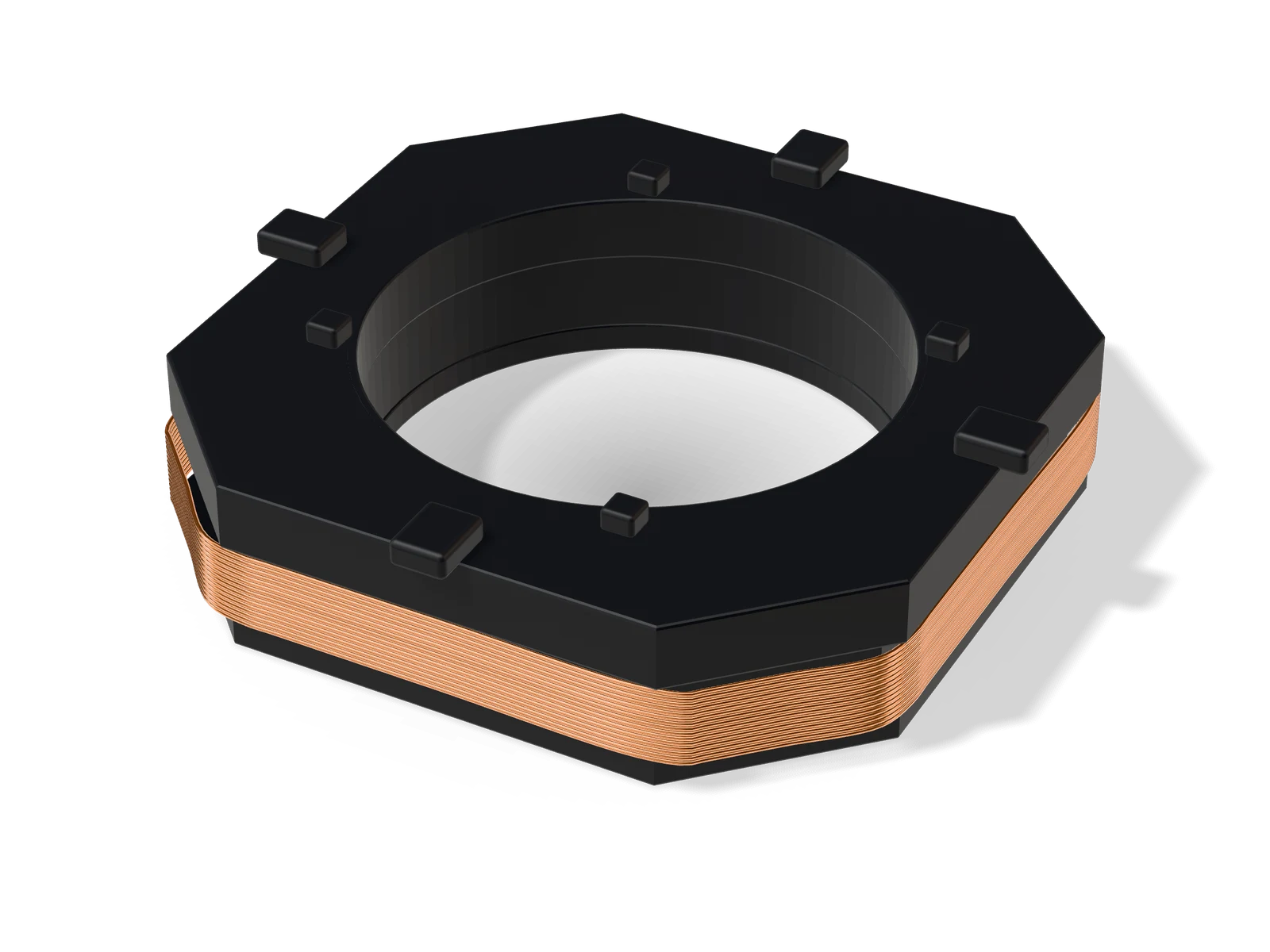
If the coil is wound directly onto the carrier, add the carrier drawing and say which surfaces are datums. The winding then shares the carrier's tolerances, which usually removes a separate coil-placement step.
Sending the drawing
Upload a PDF or STEP file with your inquiry. Engineering reviews it and returns manufacturability notes before quoting.
Questions and answers
- Should I specify turns or resistance?
- Resistance, at a stated temperature. The turn count then follows from the wire and window; specifying both over-constrains the coil.
- Why does the resistance temperature matter?
- Copper resistance rises by about 0.39% per °C, so the same coil reads differently at 20 °C and 25 °C.